
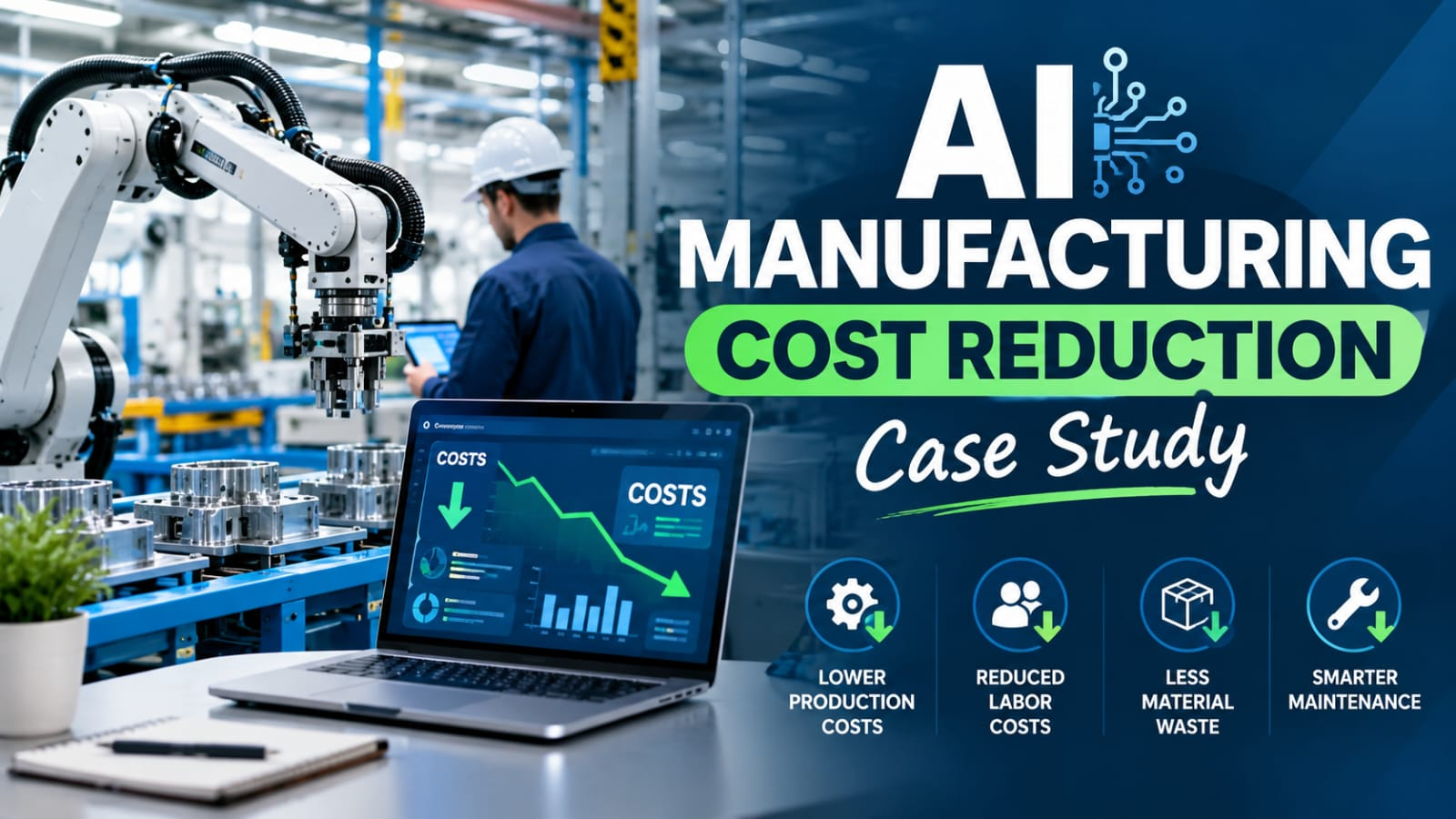
Then manufacturers can implement this knowledge in order to cut unnecessary expenses. It reveals how artificial intelligence can enhance various production processes. Such as maintenance, materials usage, energy usage, and quality.
The purpose of this technology is not to replace employees with smart technology. But to enhance current processes with the help of information. And to pick the right AI technologies for solving those problems.
Why Manufacturing Costs Keep Rising
Machines can fail unexpectedly at crucial times of production. Waste of materials can increase as well if production parameters are not set accurately. The costs associated with energy can go up due to inefficiencies of machines. Poor quality can also result in extra costs through returns and rework.
The labor time can be increased because of the need for manual supervision of repeatable processes. The AI Manufacturing Cost Reduction Case Study can help connect these issues. AI solutions gather information from sensors and production software of machines.
How AI Finds Hidden Waste
The AI system naxovyx.com can analyze manufacturing data much faster than a manual approach can. It can analyze data obtained from machine readings, manufacturing data, and quality data. These systems can detect anomalies even when there is a normal manufacturing process.
They can detect any anomaly that is indicative of the presence of a problem in the machines. AI can also identify stages of the production process responsible for material wastage. This will allow the management to make further investigations in these areas.
Production Data Analysis
It is capable of comparing production speed with the use of materials and energy. This makes it possible to discover processes using excess amounts of resources.
Machine Performance Monitoring
AI is capable of constantly monitoring the critical indicators of machine performance. It is able to detect any abnormalities that may occur before the equipment breaks down. This gives the maintenance staff the opportunity to address the matter in advance.
Waste Pattern Detection
It can analyze the patterns associated with particular machines or processes. Managers can then target the improvements for particular production sections.
Predictive Maintenance and Machine Efficiency
Unforeseen failure of machinery can become a great source of manufacturing costs. The system can evaluate temperature, vibration, pressure, and operation of the machinery. It can determine symptoms that would indicate the need to pay attention to machinery. In this way, unnecessary emergency maintenance operations can be avoided. Also, companies will be able to manage the use of spare parts more efficiently.
An example of an AI manufacturing cost-saving case can prove this point. Let’s consider the case of a factory running different machines around several shifts. Before AI monitoring, maintenance of the machines was performed at regular intervals. Some machines were maintained, although their work was satisfactory. Other machines faced some issues between regular maintenance procedures. AI monitoring allows managers to get more data for their decisions about maintenance.
Reducing Material and Energy Waste
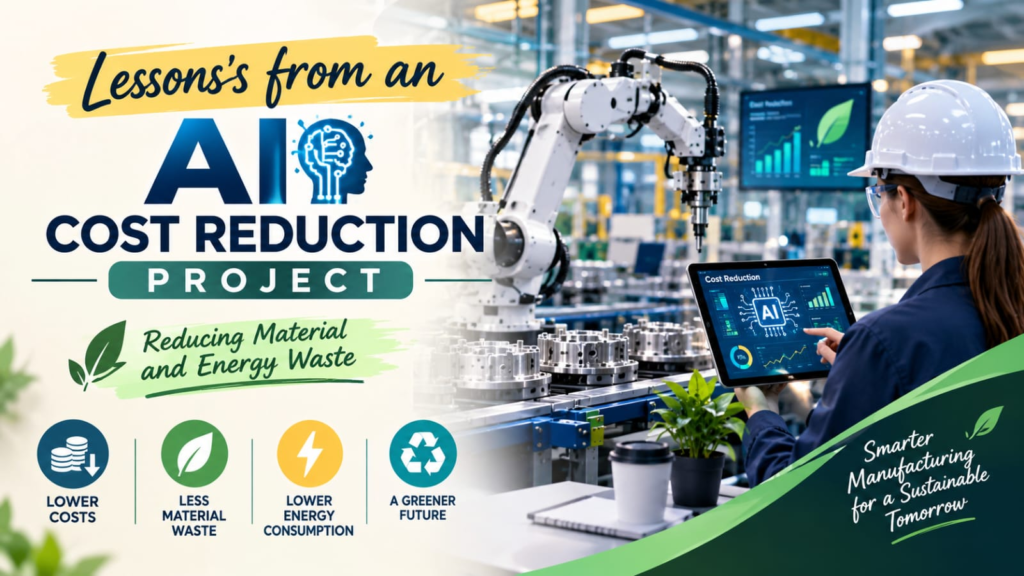
Direct material waste is able to lead to an increase in the costs of manufacturing. Direct energy waste can also become a more serious expense for production. AI is able to help manufacturers see how these resources are being wasted. It can analyze the production environment and detect inefficient modes of operation.
For instance, machines can use extra amounts of energy while performing some tasks. AI will be able to reveal such modes through monitoring production all the time. After that, manufacturers will be able to change their settings and operating modes. All of this can be done without changing the whole production process.
- AI can spot the use of excess raw materials in production processes.
- AI can spot abnormal energy usage in specific periods of production.
- AI can make comparisons on material use in different production batches.
- AI can spot the creation of waste through certain settings.
- AI can aid in production planning and resource allocation.
- AI can analyze energy usage trends in different shifts.
- AI can assist managers in investigating recurring resource consumption issues.
Improving Product Quality With AI
Quality failures will result in implicit costs to production companies. The defective products may need rework, replacement, inspection, or disposal. All these processes require raw material, labor, time, and energy usage. AI technology can support the identification of any defects in the manufacturing process of manufacture. Computer vision technology can examine the products using cameras and image analysis. It will be able to detect any visible faults in high production volumes. The AI can analyze quality data to determine repetitive quality patterns. This will aid production companies in understanding the causes of such quality problems. An AI manufacturing cost reduction case study can link quality improvement and savings. Quality improvements can lead to less rework and raw material waste. Quality improvements can also ensure production uniformity in other manufacturing shifts.
Faster Defect Detection
An AI-based inspection system can perform an inspection on the goods while they are being manufactured. They are able to detect any visible flaws in the goods before they enter the next stage. Early detection would help to reduce production with any flaws.
Consistent Quality Monitoring
AI is able to monitor the products by adhering to constant criteria for inspections. Such monitoring may be of great assistance in situations of heavy production.
Root Cause Identification
It will be possible to compare the defects with the production situation and the machines. This will give insights into some pattern that is responsible for quality defects. Managers will be able to analyze the production situation in detail.
Measuring Cost Reduction Results
An AI manufacturing cost reduction case study needs measurable results. Results help in knowing whether the technology is supporting the business goals. The measurements may include production efficiency, maintenance, waste quality, and energy.
- Record downtime on the machine before and after AI installation.
- Record waste of materials during equivalent production times.
- Record energy usage during equivalent production times.
- Monitor defects before implementing automatic quality inspection.
- Record maintenance costs during different operating times.
- Compare production with resource usage.
- Check savings after implementation is complete.
Building a Practical AI Strategy
AI should not be implemented without the comprehension of the manufacturing issues. An AI manufacturing cost reduction case study may help with the selection. Thus, the solution has to be adapted to the unique production conditions of the facility. The company should start with a relatively simple pilot project. It could relate to one machine or production line. The results will be the basis for further application in the facility. The employees also have to be prepared for this transition. Workers need to know how AI assists them in their work. Communication can simplify the introduction of technology among the workers. Periodic reviews are also essential after the implementation of AI models. They might need some modifications due to changes in production conditions.
Lessons From An AI Cost Reduction Project
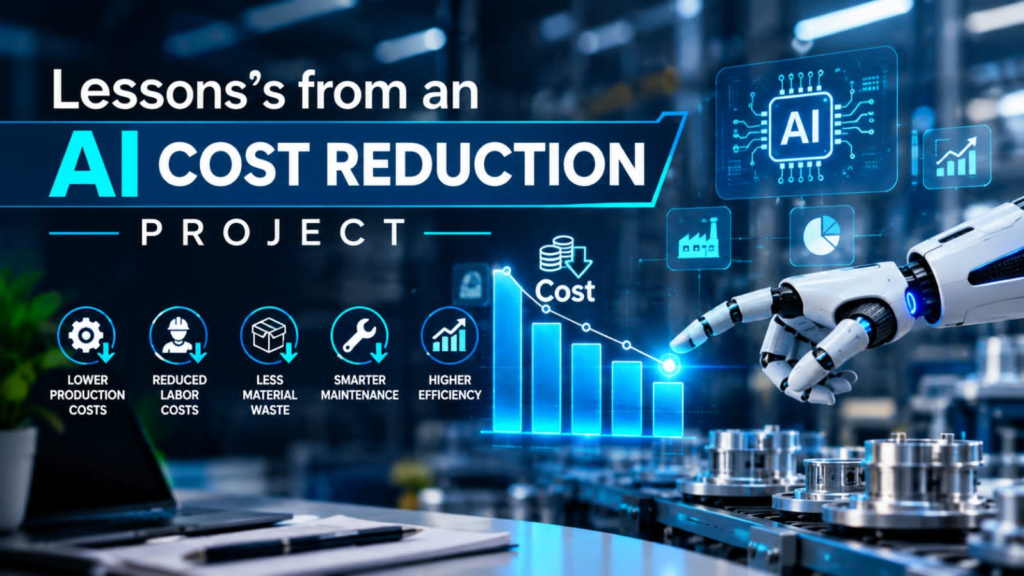
A practical AI manufacturing cost reduction case study gives some interesting lessons. The first lesson is about the significance of data. AI uses accurate data to perform proper analysis. Bad data may affect the quality of AI suggestions.
The second lesson is selecting proper business goals. Firms need to know what kind of expenses to decrease. They also need to determine ways to measure success. An important lesson is worker participation in implementation.
Conclusion
Case Study on Manufacturing Cost Reduction Using AI Technology Demonstrates the Role of Technology in Modern Manufacturing. AI is able to detect patterns of waste not seen with the help of traditional monitoring systems. It is able to assist with predictive maintenance and increase the efficiency of machines. Material waste and energy losses can also be decreased with the use of AI. Companies will require precise data, a set of objectives, and an implementation strategy.
Pilot projects are a good way for companies to learn about practical benefits prior to expansion. Employee participation is still needed in the implementation process. Workers may share their experience with production difficulties. AI is most effective when technology and human expertise complement each other. Measurement is a way to find out if the desired results are achieved. Manufacturers should think of AI technology as an ongoing process.
FAQs
What is an AI manufacturing cost reduction case study?
It describes the way through which AI will cut down the cost of production. Normally, it evaluates issues such as wastage, maintenance effectiveness, and energy use.
How can AI reduce manufacturing costs?
AI is able to detect inefficiencies in the process as well as production irregularities. AI is able to assist managers with improved maintenance, utilization of resources, and planning.
Can AI reduce material waste?
AI is able to analyze production information and determine patterns of wastage. This way, manufacturers can change processes that cause material wastage.
Is AI expensive for small manufacturers?
The cost of AI varies with technology and technical requirements. Small manufacturers may start with small-scale pilot projects and applications.
Does AI replace manufacturing workers?
The application of AI will not automatically make workers obsolete in manufacturing. It can help workers by automating monitoring and analysis.