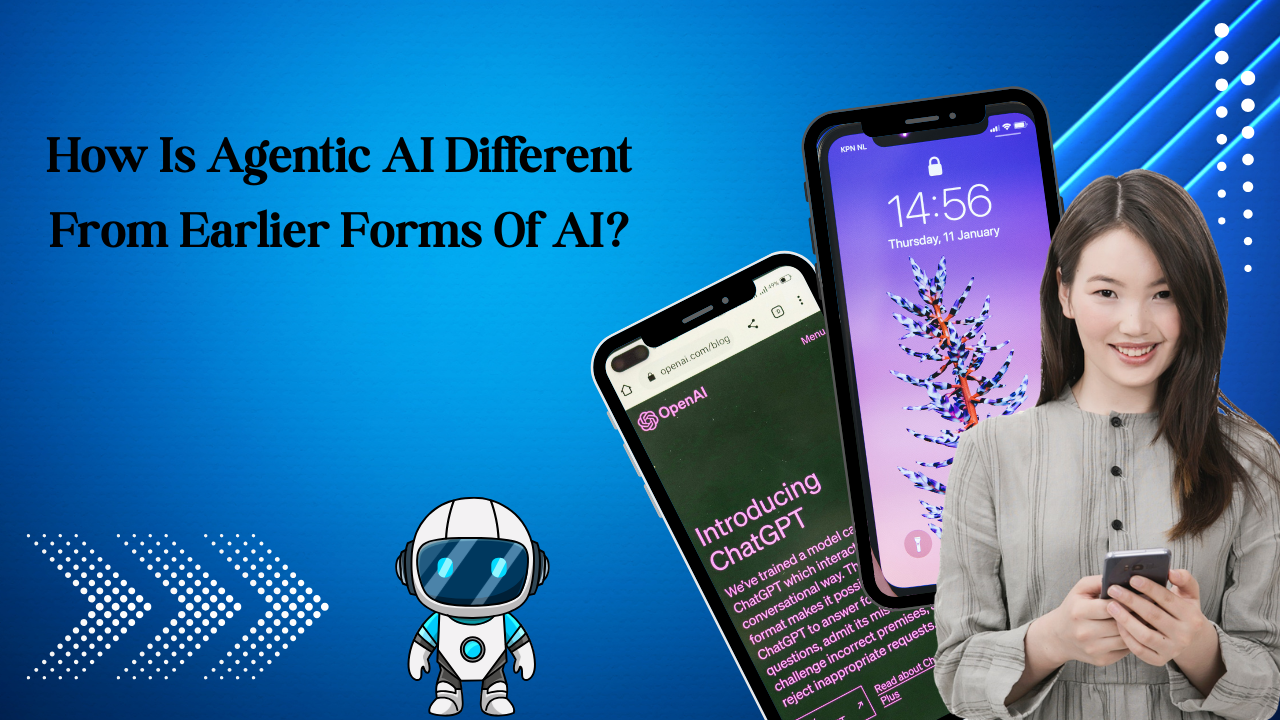
How is agentic AI different from earlier forms of AI? In this article Learn the key differences, capabilities, and benefits of agentic AI in simple terms.
Artificial intelligence has revolutionized various areas in digital workflows. It can answer users’ questions and perform certain tasks. However, in general, they required human supervision throughout all stages. In contrast, the latest AI systems can execute multiple related tasks.
This strategy is often referred to as agentic AI. This type of AI is more involved in the digital workflow process. One common question that people ask regarding the differences between the new AI system and its predecessors concerns its functionality. While the former AI responded to a prompt or input, agentic AI receives the goal and creates several actions.
It is able to select the order of these actions. Then, it performs the actions independently without the need for human instructions. In addition, the agents can respond in case of an unsuccessful attempt at performing a particular action. In this way, these agents become useful for digital workflow processes. However, these systems require restrictions.
What Is Agentic AI?
Agentic AI means artificial intelligence capable of working towards particular objectives. Such types of AI are capable of planning processes rather than providing answers. They can set up a sequence of actions for accomplishing the primary aim.
The system uses various tools for completing each step of the task. It evaluates the results achieved at one stage and proceeds to the next one. Thus, the agent becomes an active part of the task accomplishment process.
For instance, if the user asks the agent to conduct research on a particular subject, it identifies the sources that are necessary for accomplishing the task. Then, the agent extracts relevant information. The latter is sorted by the agent and analyzed further. Information is compared, and a report is prepared.
Experience:
- Task-oriented AI can make one’s daily work simpler through automated processes that require minimal human effort.
- I thought it to be quite effective in optimizing workflows and minimizing the time required for performing repetitive processes.
Earlier AI Systems and Their Main Role
They had the capacity to process data and give a relevant output. Chatbots had the capability to respond to users’ queries. Translation software could translate text into a particular language.
Recommendation engines could make recommendations on products or videos. But they had to wait for another command before moving forward. A user was in charge of controlling the entire workflow. Generally, the system was not in charge of the entire workflow.
- From Answers To Actions
Traditional AI was primarily concerned with giving users the correct answer.
- From Single Tasks To Workflows
On the other hand, agentic AI links many tasks together in order to accomplish one particular purpose.
- From Instructions To Goals
Older tools were usually dependent on user instructions. Agent-based systems, on the other hand, can operate based on goals or objectives.
Experience:
- I have observed previous AI systems to function on the basis of simple instructions and tasks.
- They did perform well but required more human intervention for difficult tasks.
How Agentic AI Plans Tasks
The next important feature that the agent should have is planning. Firstly, it should understand the goal set by users. After that, it can divide this goal into several tasks that will play certain roles in the workflow. The agent may decide which task to perform first and do the others.
Thus, such an ability provides the chance to solve various problems. Then, the information may be sorted according to certain categories. The data may be compared somewhere in the process of performing tasks to produce a report. Finally, the user may use the research.
Experience:
- I found that agentic AI can break complex tasks into smaller and easier steps.
- This makes the overall workflow more organized and easier to manage.
How Tools Make Agentic AI More Useful
Tools increase the ability of agentic systems to do tasks. Without tools, an AI system is primarily an information provider. A business agent can organize information collected from various sources. An agent can use a tool and then proceed to further actions.
Output of one tool can become the input for another task, thus creating a connected workflow that includes several actions. Tools increase the ability of agentic systems to do tasks. Without tools, an AI system is primarily an information provider.
Common Agentic AI Tools
- The search tool may be useful for information search.
- Code tools may assist agents to assess software and review it.
- File tools may assist agents to read files containing important information.
- Data tools may assist agents to sort huge amounts of data.
- Email tools may assist agents to prepare tasks related to communication.
- Application tools may assist agents to perform integrated workflow management.
- Research tools may assist agents to compare useful information.
Experiences:
- Found that access to tools makes AI more viable, as it enables one to perform many tasks at once.
Limits And Risks Of Agentic AI
The use of agentic AI can prove beneficial for many different industries. On the other hand, the enhanced ability to perform actions is associated with increased risk. The agent may misinterpret the primary purpose of a task. Furthermore, an agent may be using inaccurate or incomplete information. A mistake at the early stage of the process can influence the further outcome.
An agent may be allowed to edit the file or the information. It may act without the user’s consent. Setting up strong permissions and setting up clear boundaries may help in avoiding these issues. Users should give access only to those tools that are necessary.
Moreover, human review is also an essential part of the process. People need to verify important results before doing anything else. In addition, people need to review the information when it is highly important. Logs can also be used by users to understand what an agent did.
Safe Ways To Use Agentic AI
- Provide the agent with a specific goal and appropriate context.
- Restrict access to the tools required by the agent.
- Refer to reliable sources for critical information.
- Verify the critical results before proceeding further.
- Introduce human intervention in important actions.
Experiences:
- may not always produce the expected outcome.
- Human intervention is necessary where the task at hand involves vital information.
Future Of Agentic AI
Agentic AI might gain more popularity across multiple digital workplaces. There might be more software systems that would provide agents capable of assisting in completing certain workflows. In particular, such assistants might assist with research, customer service, coding, and business activities.
Future systems might gain the capability of planning more sophisticated workflows and tracking their results. Better tool management might assist in facilitating the integration of agents with different apps, and enhanced control would help to limit any undesired behavior.
However, it will be important to have enough oversight of the process in question. Future developments might include increased interaction and collaboration between human operators and AI systems. The latter are capable of handling repetitive actions and processing information, while people will be able to focus on goals and decisions.
Experiences:
Agentic tools would definitely be used more often in the workplace, according to me. They would be used along with human oversight and control.
Conclusion:
The advent of agentic AI changes the paradigm of how artificial intelligence can be used by people. Previous types of programs were mostly designed for giving responses and accomplishing certain tasks. Usually, users needed to give instructions for the following steps.
Agentic programs are able to perform multiple interconnected actions to achieve some particular goal. It is possible to distinguish such a feature of an agent, such as the ability to plan and accomplish actions. Thus, they can be useful for complicated digital processes.
Answering the question of how agentic AI differs from previous AI types is quite easy. Mainly, the difference is related to autonomy and task management. While previous forms of AI reacted to user input directly, agents can do several actions after obtaining a larger goal from a user.
Agents can be used in the process of selling and conducting research. The advent of agentic AI changes the paradigm of how artificial intelligence can be used by people. Previous types of programs were mostly designed for giving responses and accomplishing certain tasks.
FAQs:
What is agentic AI?
Agentic AI is defined as a machine that has the capability of planning and executing the job. The machine does the job using certain resources to achieve a particular objective.
How is agentic AI different from earlier forms of AI?
Agentic AI can plan actions with some goal in mind. Agentic AI can also use tools to act.
Can agentic AI work without human input?
However, there are certain activities that can be carried out without any human effort. The objectives, authority, and decisions need to be controlled by humans.
Can agentic AI use external tools?
Yes. Tools can be used by agents whenever they are made available to them. These tools can include searches, coding of files, data, etc.
Is agentic AI always better than traditional AI?
An agentic system is not always required for an action. An action may be performed in a simpler way without the help of an agentic system.
What are the main risks of agentic AI?
However, agents can make errors and can have incorrect information. Agents can also perform unintended actions using the resources that are associated with them.
Why is agentic AI important?
Agency in AI allows a combination of several actions to form one procedure. It is capable of removing repetitive tasks and human intervention. It allows individuals to carry out complicated tasks using digital devices.