Do you love technology? You must surely have heard about the terms called “AI,” “machine learning,” or “deep learning.”
But to many, its true meaning, as well as how they relate, is obscure. Which is really on top of the others? Which lies under the things they are using?
Whatever, in this article, I will reveal answers to all these things for you all.
EASIEST WAY TO VISUALIZE THEDIFFERENCE
Friends throw these words out almost constantly: It may seem like they say and even in text write down a little similarity, and then mix both these up.
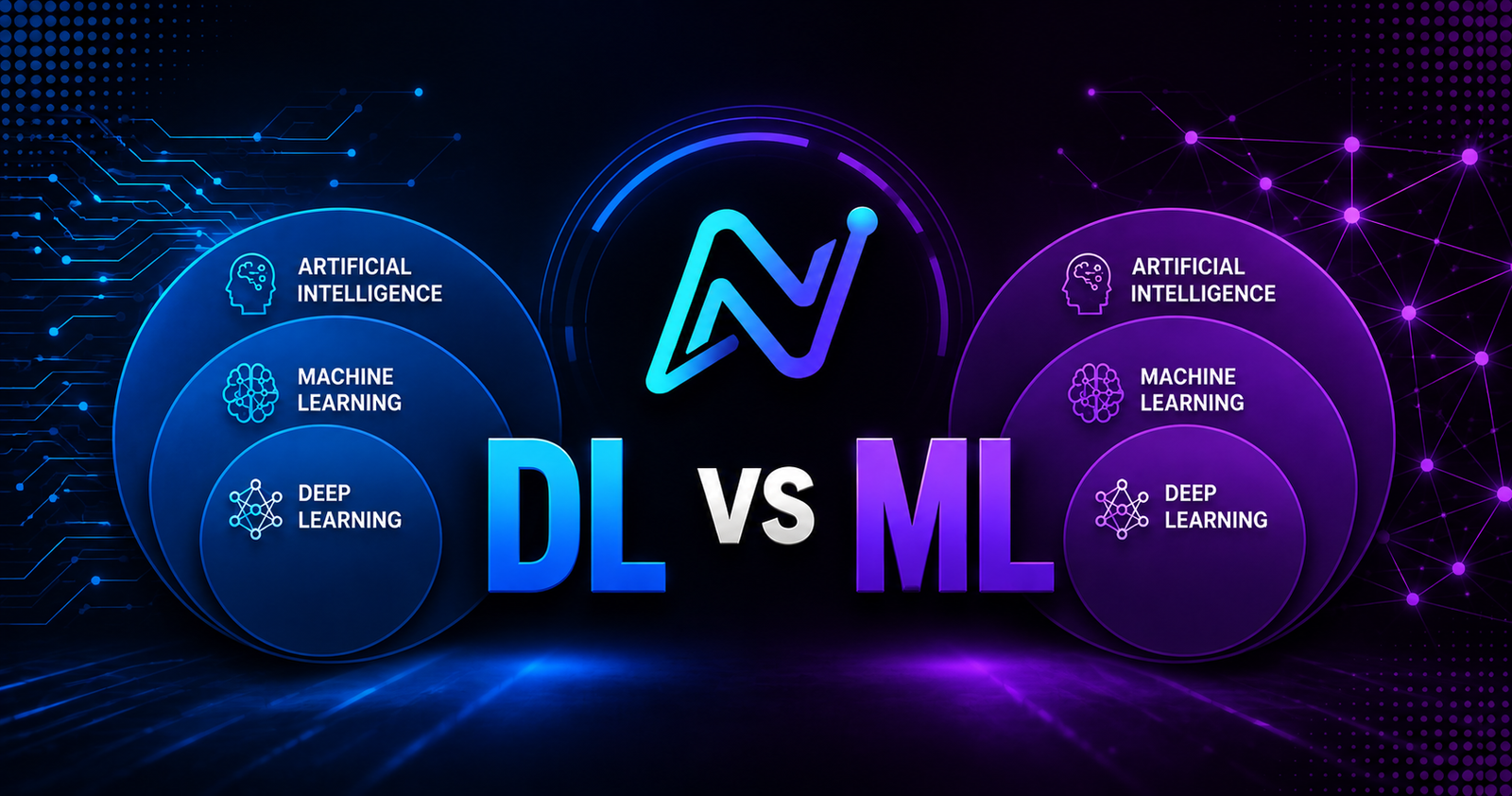
But, no. The three names represent three sizes of precisely the same thing that’s the concept. Take an instance if you can imagine a big group, inside it a midsize circle & inside again the smallest one(like the dolls Russian)you must understand! The biggest round(A I) is nothing, then machine learning that’s nothing beyond the big round and eventually the tiny round which we see under both of them – deep learning.
In simple terms :
1. A.I(Artificial intelligence) Machine trying the do things that typically humans could do, such as recognize something ,understand language etc.
2. Machine learning Machine that learns from the data rather than adhering to only instructions compiled by humans.
3. Deep learning A sort of machine learning which relies on deep structures mimicking human thinking in networks & algorithms, often used for facial identification or voice detection.
As an end note, we all can just come to the conclusion that : ALL DL is machine learning; ALL machine learning is AI. It is quite interesting!
ARTIFICIAL INTELLIGENCE – THE BIG IDEA
AI is the broadest of all three. It refers to any computer system that attempts to mimic human thought. This can include systems that simply don’t learn at all.
A chess program from 1990 was AI; it didn’t do any learning, but it had an algorithm written by programmers which analyzed and followed chess rules.
It was able to beat humans at chess, but it didn’t improve beyond human input. It analyzed millions of possibilities according to rules provided by people. That’s “Good Old Fashioned AI” or rule based AI, and we still have it around us. Calculators working out math quicker than a person does it, working out a problem a human would do.
The autopilot in an airplane works on rules, to keep it at level flight.
A thermostat with a schedule tells it when to turn on the heating based on rules you set. In simple terms, AI is concerned with making machines seem intelligent, however it goes about doing that may be by rules or by learning.
MACHINE LEARNING – THE WAY MOST MODERN AI WORKS
Machine learning is a branch of AI. Instead of rule based AI, where a person tells the machine precisely what to do under certain circumstances (e.g. If the photo has a pointy ear it is a cat), with machine learning it learns itself.
The computer is shown thousands of examples of animals; it’s shown cats, and it’s shown dogs, and figures out how to tell the difference.
The learning is done by the computer, quite simply by giving it lots of examples (data). It tries to find patterns and attempts a guess; you correct its mistakes. It then recalculates to get the answer right; you repeat thousands of times until the machine gets most of them right.
Some common machine learning examples in everyday life include; spam filters in your e-mail, Netflix recommendations, banks flagging fraudulent credit card usage, weather apps getting more accurate with weather forecasts each time they run.
Machine learning became common in the early 2000s, due to an increase in computer speeds and vast amounts of data available.
It’s highly likely that the majority of the AI you use today is actually machine learning.
DEEP LEARNING – THE POWERFUL PART OF MACHINE LEARNING
Deep learning is a method which falls under machine learning and involves the use of neural networks. Neural networks are simply a series of algorithms that work together and have the ability to ‘learn’. The ‘deep’ aspect comes from having many neural networks stacked on top of each other and this part of machine learning took off primarily in 2012 and then really exploded in 2016.
Speech recognition, translation and image recognition by machines improved dramatically due to deep learning.
The feature you need to be aware of with neural networks, compared to machine learning is its ability to pick out features itself. In the example used for machine learning of image recognition (cat/dog photo), a human might need to identify relevant features in the photos such as a point ears.
However deep learning features can work on the most abstract features the computer has found, that may be completely alien to us humans. However with deep learning you get what you put in and feed a deep learning machine an absurd amount of data and it can become incredibly accurate and work at much faster speeds.
It normally operates at high speeds by running on graphics processing units (GPUs).
The obvious examples here would be chat assistants, such as ChatGPT; facial recognition; voice assistants; self-driving cars; and text generators that create images. Any example of a machine recently creating something artistic from the text description is most likely deep learning.
AN EXAMPLE ALL THREE:
Photo App Image provided. A smartphone photo app delivers all three types at the same time. AI is the part of the app that performs the smart behavior. (e.g., all of the pictures that have people.)
That is AI, general.
ML is the part that learns from all your photos to determine which faces are yours. (e.g., it sees hundreds of times who you are and not you) That is ML. DL is the part that allows the app to identify you, even if there is not enough lighting. (e.g., it can tell your face with extremely high specificity. That is DL. One photo, three layers of the same technology.
A SIMPLE TRICK TO NOT MIX THEM UP My trick to remember the terms is as follows: AI ( Artificial Intelligence ) is the umbrella concept. (i.e., It’s the broad topic) ML ( Machine learning ) is a sub-category within that umbrella. (i.e., It is one way in which that umbrella functions) DL ( Deep Learning ) is a sub-category within machine learning. (i.e.)
It is a way a machine learns within that group.) Simply put… AI is like the term vehicle. ML is like a car and DL is like a sports car.
If you get that in your head, these terms will never cause problems for you. WHY IT MATTERS IN 2026 The distinction between these terms isn’t a matter of pointless wordplay. The three different terminologies are going to matter 3 ways as soon as you enter 2026 .
1. Career Paths ML Engineers and AI Engineers are distinctly different job titles.
In other words, to build a machine that learns, it requires certain skills and capabilities which AI Engineers and Machine learning engineers utilize differently. An ML engineer would primarily focus on building machines capable of learning.
Whereas, an AI Engineer would focus on designing rule-based machines, and in other cases learn machines or not-learn machines.
2. Business Operations If you happen to be working in a company and you require an AI solution, you’ll find out that you absolutely would not require a “Deep learning” solution unless specified so.
Why?
Well it’s easy and simple! Any ML Engineers or ML products are often cheapest and most easier to get and in many instances ML engineers do offer full coverage in order to help you automate and bring intelligence into your businesses as well.
For only such times as you are aiming for intelligent outputs from speech recognition devices to images on the ground you want a Deep learning engineer/ product to be of value to you.
3. Information: Knowing when one particular output/ Product makes use of” ML or DL” instead of just “AI” is very crucial! Because simply put, any algorithm you run in an excel sheet will technically do nothing but create it just in the simple formula run through, or to make something truly intelligent and autonomous to bring down error rates through its performance improvements – is where you’ll utilize and necessitate machine learning or even worse if it will fall more directly to “Deep Learning”…and that alone is how you tell what products are not just mimicking intelligently but how are the really intelligent.
What is The Future
In 2026 most real products will mix all three. Some modern chatbots rely on deep learning. They are powered by a machine learning technique, inside an AI product.
What skill is needed is not how to pick from one of the three terms, but what layer you are looking at. Deep learning is getting cheap and accessible for the future. Easy tools allow any person to access a great deep learning model just by clicking three buttons.
Thanks to this, small companies and individuals will be able to perform tasks that were previously only possible for large companies.
CONCLUSION
The idea behind smart machines is Artificial Intelligence. Machine learning without being given rules is Machine Learning. Deep learning is the real part of machine learning, using deep networks.
That technology is powering the most exciting AI products.
All deep learning models are machine learning models and machine learning models are AI models, but not the other way around, always keep that clear picture of things in mind, so that no more confusion between the three shall come.
I hope these tips will serve beneficial to your research of writing effective titles. Please share your question with regard to the usage with others in the below box.